Issue 01
The Current Selection
Artists who keep making their way
Three first looks at work shaped by heritage, underground culture, political memory, and persistence.
Sybil Amboise
Nature, contours, and identity - words by Denva Beaubrun
Sybil Amboise has a Haitian background, which he showcases in some of his art. Most of his art is abstract. It moves through themes of nature and contours. When he starts his pieces, he doesn't plan, per se. He goes along as he goes, and still he produces masterpieces.
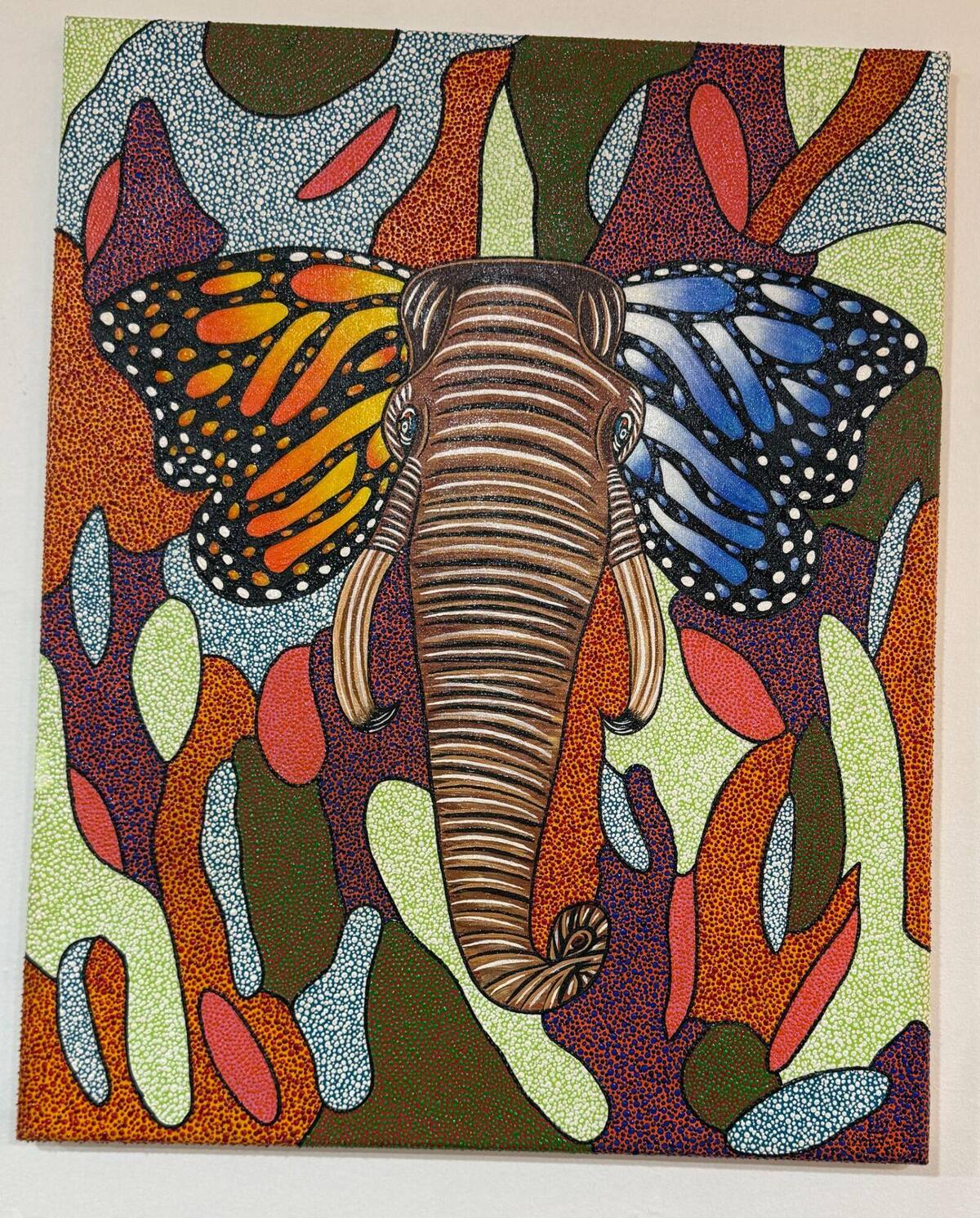
One of his favorite pieces is an elephant, which ties in with nature. It is made entirely of dots. The elephant has two butterflies for ears: a blue butterfly on the right and an orange butterfly on the left. The butterflies have similar patterns. The trunk showcases descending lines of white and black on top of its brown background.
An abstract piece inspired by a forest features leaf-like biomorphic shapes densely layered across the canvas. The palette is grounded in brown and green, with recurring accents of teal, pink, and orange running throughout. A border of dotted linework curls and swirls around the edges, echoing the organic movement found within the piece itself.
Another cool one is a flame-like work that connects three people in one. He uses similar leaf-like biomorphic shapes in the flames. The main person in the middle is a woman; on the right is a man, and on the left is a woman. The colors are green, orange, and orange-red. Some dots also appear in the biomorphic shapes. A lot of his pieces contain only these shapes, sort of like patterns on a bandana.
The brown one has contours and kind of reminds me of a cactus with holes. Green, blue, and red lines peek through the holes. The contours are like branches running through the piece.
Overall, his art is mostly abstract, but sometimes blends in his identity or becomes a bit less abstract. His pieces work together well, with colors that match. His art doesn't always stay abstract; he experiments with different themes. One work features the basketball player Rodman. He plays around with abstract layers of blobs in purple, green, orange, and more, in the background and on the player's scalp.
Sybil Amboise - artist plate
See more available work by Don Sybil
From Punk to Pussy
Karl Kotas and the art of resilience - words by Denva Beaubrun
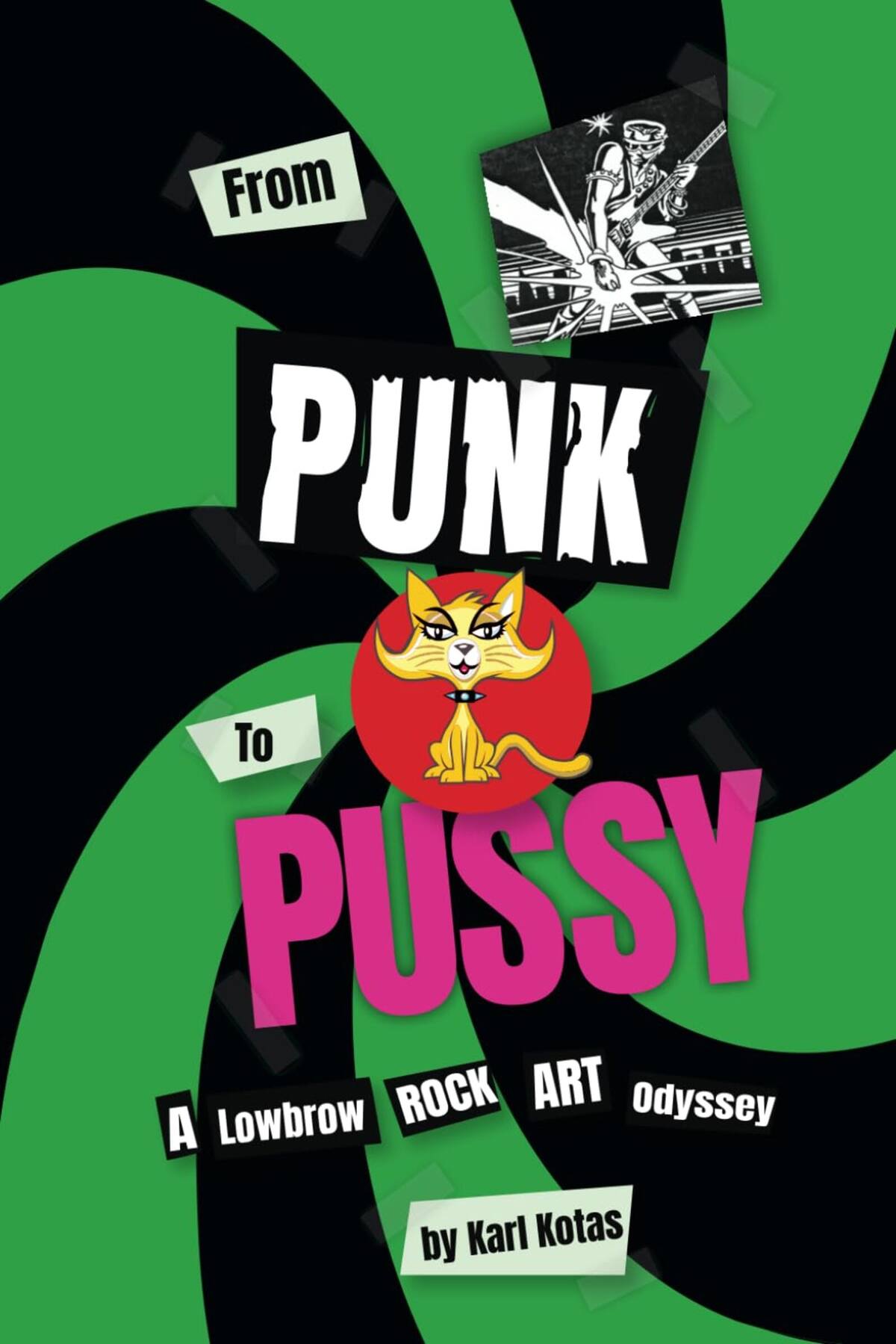
Karl Kotas's art tells a story of resilience and never giving up. This is a scrapbook-memoir hybrid, combining Kotas's own art with the art of artists he encountered along the way. It traces a journey from barely making it to making it: a hard and long road, but ultimately a paying one.
It serves as a chronological gallery through the scenes he passed through. He gives a story behind each place he visits and the story behind his art. Each one gets its own chapter, with first-person prose and lots of art. From the first page, he makes clear that punk is the deep appreciation guiding everything in the book.
The journey moves through San Francisco's punk world, Buffalo's dying industrial scene, Hollywood, back to Buffalo again, and finally New York City. In each place, he hits hardship, and each hardship pushes him closer to his breakthrough.
San Francisco gives him his first real break: an art director job at a punk magazine called New Wave. It folds within a few months. At one point, he's paid not in money but in beer and secondhand furniture. He recalls moving back to Buffalo as one of the worst decisions he ever made, but even that dead end turns into work: gig posters, local band branding, and a connection to Rick James.
Later, working for the 2006 World Cup, he's assigned to design the mascot, a lion named Goleo. His version comes in second place to one designed by the Jim Henson Company, but his is still officially licensed by FIFA. It stays unapologetically his: underground-comix style smuggled into a mainstream sports mascot.
That style carries through the majority of his work, including the cover of Mary Monday's 45 rpm single I Gave My Punk Jacket to Ricky, for which her manager gave him $50. Kotas took what he could get, even if he was underpaid or not paid at all. He wanted his art to be seen.
In Buffalo, he encounters art that is rougher and more chaotic than San Francisco's, and it inspires his own. His work includes pieces for The Fems, a band whose name comes from a funny idea to go against the status quo of it being an insult to be called a “fem.” He designed a cover that featured cartoon people drinking and smoking in a party from hell, smoke coming out of their noses and the room locked with no exit. From then on, he became their official artist, creating performance posters, often with skeletons and grungy rock-and-roll cartoons.
The book follows him to Manhattan, where the hustle finally starts to pay off in more than beer and furniture. He falls in with the “Lords of Lowbrow” crowd at Ozone Gallery in SoHo, showing alongside artists like KAWS and Joe Coleman. Later, he lands a working space inside Electronic Hollywood during the dot-com boom, drawing in a Flatiron loft full of “darlings of the digerati.”
Along the way, he swings through pure abstract acrylic painting and a handful of pop-art portraits, among them Don Draper and a “Maidenform Woman.” They prove that the underground-comix line was never the only mode he could work in, just the one he kept coming back to. He also shows at Fountain Art Fair, a scrappy Brooklyn and Bushwick alternative to the Chelsea gallery circuit, named as a wink at Duchamp's urinal and more interested in beer and DJs than posh collectors.
From there, the throughline tightens into the tiki illustration he becomes best known for. He traces its origin to a package design job for a men's product called Man of Wood. The client abandoned the project, but the tiki character he'd drawn stuck with him and turned into a decades-long fixation. It eventually led to a collaboration with the industrial band Lords of Acid on a series of NFT drops, the newest distribution technology in a career that has chased a new one every decade.
Midway through the book, he breaks format for a rapid-fire Q&A interview, the kind that asks about his favorite animal and dream job as readily as his art. His voice comes through the clearest here: blunt, self-mocking, and entirely unbothered by whether the reader takes him seriously.
Karl Kotas - From Punk to Pussy
See more available work by Karl Kotas
Lesny JN Felix
Collage, culture, and memory - words by Denva Beaubrun
Lesny JN Felix has progressed in art over the years. He's explored different themes and mediums, including collages, paintings, and art with light. He incorporates his stories, or his view of the world, into his art. The art tells stories of struggle, fondness, passion, and appreciation for his culture. Overall, he is a great artist who has used what he has to make art and satisfy his growing passion for it.
The collages tell stories. They have a path and a progression. They tell stories of art, fashionistas, history, politics, and more. Cutout images build onto other images to tell a story, and they all come together around a major theme.
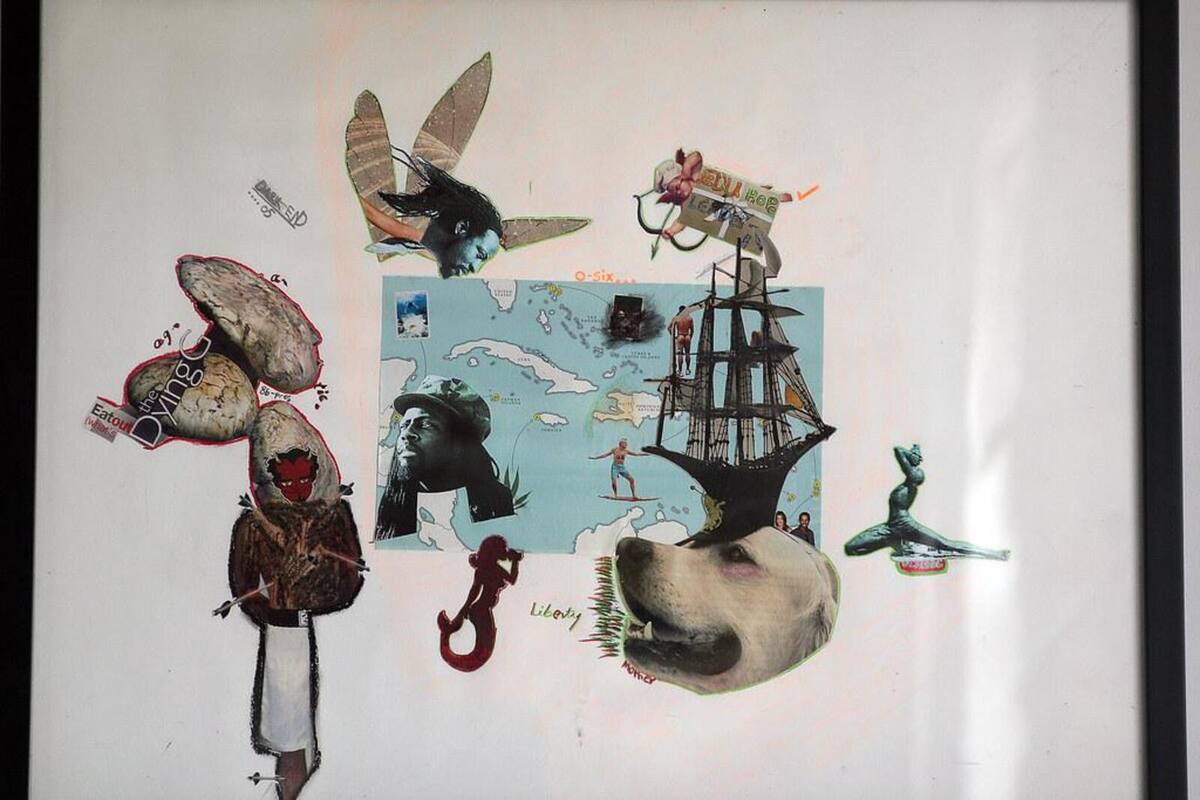
The democracy collage is more than politics; it has a historical path. A map is displayed in the background with a ship, like Christopher Columbus's conquest. It makes sense that a mermaid is displayed near the map, since Christopher reported seeing mermaids on his conquest. The map fits well as a Caribbean/Bahamas map, tying into the artist's fondness for Haiti. He draws from how much turmoil Haitians and Haiti have experienced and wanted to show it through his art. An Indigenous person stands on the map, wearing a breechcloth. Words like “liberty” and “money” are displayed. A devil stands to the side, expressing the evil of it all. The main theme is colonization.
There are other themes in the collages, like fame. Art can be expressed through clothes, and models perfectly display that. Fashionistas pose left and right in their outfits. The female models are dressed in fun patterns, including lines and blocks of color. There's a playful magician-like outfit paired with a flower. I'd call it a sexy version of a magician's outfit because of the fishnet stockings.
The strategist collage is similar but different. It also displays a female model, but her body tells the story. Bright shapes and circular loops show wildness, and the lemur brings in themes of Madagascar. It's tied to New York Fashion Week, when the colors of the outfits and themes were bold, bright, and colorful.
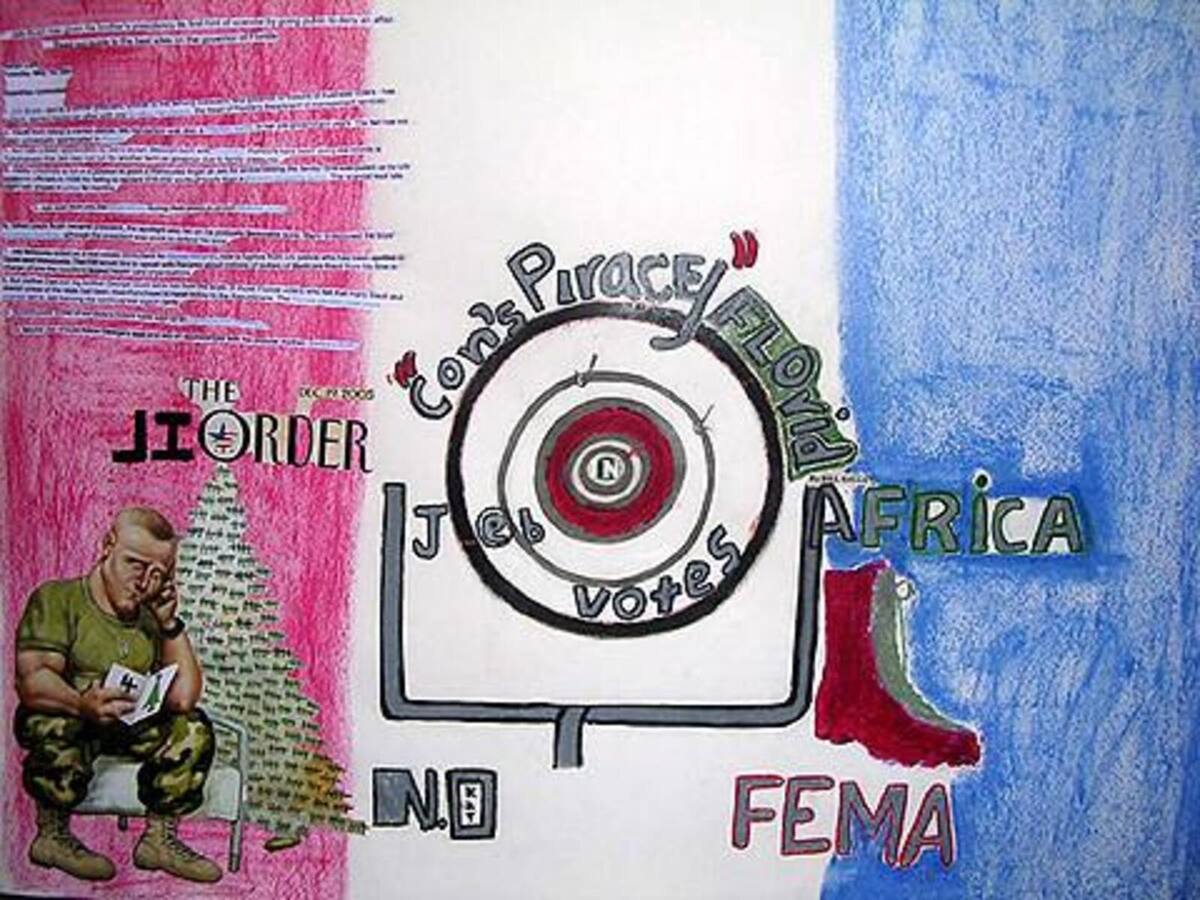
Some political works are Humble and Political BS. Political BS is more direct, split into pink, white, and blue, like the country is being pulled apart. On the left, a soldier in camouflage sits reading, tired of it all; above him, “the disorder.” In the middle, a target is wrapped in words: conspiracy, Florida, Jeb, votes, the 2000 election, and the Florida recount. On the right, Africa, a red boot, and FEMA with N.O. in the middle: Hurricane Katrina. It's disorder on every side, circling back to the system failing the people who needed it most.
Political BS ties right back into Humble. Humble had “wants” arrowing down into “NO,” that personal shutdown. Political BS is the same shutdown but for the whole country. Humble asks if you can stay humble surrounded by chaos. Political BS answers no, because the chaos isn't personal; it's built into the system.
We move on to one of Felix's famous pieces, 99 Problems. Similar to a collage but different, it's a mixture of collage on canvas. Not wanting to break the bank, he used a common resource: wood. The piece harbors the struggles of coming up. It features historical figures like Rosa Parks and the difficulty of life, hence the iron, which means “hard press.”
The paintings are similar but different. They share the cutout image aspect of the collages, and they also tell stories. They feature similar themes of models, nature, and patterns. The paintings are more pattern-filled, or use more drawings, than the collages.
One piece is mostly drawings and resembles tiki art: a surreal, primitive-style composition blending tiki-inspired totemic figures with medieval knight-like forms, armor-like shapes, masks, shields, and intricate earthy patterns. It also gives a folklore vibe. Some of Felix's older art, made in 2005, shows similar patterns of pictures and theme. One work features creatures or ocean life: drawings of whales, bears, and sand.
Overall, most pieces include patterns or drawings with cutout pictures that show a bigger picture. Some are a bit abstract, but show tiny details that reveal there's more at play, like the painting Les Femme en Danger. It may seem abstract, but a closer look shows a woman on the side and a candle. Tied to the title, which means “Women in danger,” this could point to the theme of a woman's suffering or her being harmed.
Last Bath also appears abstract, but a bathtub is centered in the middle of the painting. A person's attention is immediately drawn to it, and the title helps you fill in the gap.
The beautiful painting C'est Fleur Pour mon cherie D'Haiti, which means “This beautiful flower for my darling Haiti,” shows the artist's fondness for Haiti, where he was born. The flame shows burning passion for the country, and the flower shows appreciation, as if throwing flowers to the country.
The next pieces mix colorful electronic art and variations on it, including diamond-shaped neon lights connected throughout. Flower Dancer shows flowers as its theme, with patterns around them and worm-shaped petals to suggest moving or dancing. Glowing LED uses more neon-like glow patterns and LED lights.
Even cooler is a trippy, pattern-filled work. Triangles blur into the background, giving the illusion of entering a dimension or moving quickly through time. The geometric patterns are three-dimensional, which puts you right in the painting's time and place. A similar trippy piece is made entirely of dots. Emboss Glowing repeats the pattern of Glowing LED, but with fewer patterns, so you can make out the shapes more clearly. The shape on the right looks like a girl if you look closely.
Lesny JN Felix - artist plate
Lesny JN Felix - artist plate
See more available work by Lesny JN Felix
The Current Selection
Get Issue 02 first
New essays, new artists, and the works themselves, straight to your inbox.
SubscribeWords by Denva Beaubrun - (c) 2026 Current Arts
The Current Selection is published by Current Arts, a nonprofit gallery on the Lower East Side, New York.